
What to Know Before Installing Coilovers on Your Street/Track Car
If you’re serious about performance driving—whether it’s autocross, HPDE, or just aggressive back-road sessions—coilovers are one of the most impactful upgrades you can make. But with great adjustability comes great responsibility. Without the right plan, it’s easy to spend big and still fall short of your goals.
At Atomic Autosports, we help drivers upgrade suspension systems with purpose. Before you install coilovers on your street/track car, here’s what you need to understand about ride height, spring rates, damping, corner balancing, and alignment—and how we make it all work together.
1. Ride Height: Lower ≠ Better
One of the first things coilovers let you do is lower the car. But a lower ride height doesn’t automatically mean better handling. In fact, lowering too much can ruin geometry, increase bump steer, and reduce suspension travel—especially on platforms like the Miata or S2000.
When we set ride height at Atomic Autosports, we prioritize:
- Suspension travel over aggressive aesthetics
- Proper rake and weight distribution
- Ground clearance for track curbing and real-world driving
Goal: A ride height that keeps the suspension in its optimal operating range—not slammed for looks.

2. Spring Rates: Balance Over Bragging Rights
Spring rates are one of the most misunderstood specs when it comes to coilovers. Stiffer springs don’t automatically make a car handle better. What matters is how the spring rate matches your use case and your damper’s ability to control it.
We help you choose rates based on:
- Vehicle weight and weight distribution
- Tire compound and wheel setup
- Driving goals (street-biased vs. track-heavy)
- Surface type (Mid-Ohio vs. Nelson Ledges vs. street potholes)
Example: A dual-purpose NC Miata might run 8k/6k springs for balance. But a C5 Corvette on 200TW tires might benefit more from carefully chosen mono-leaf replacement options with sway bar tuning.
Goal: Keep the tires in contact with the road. Balance front and rear response, not just stiffness.
3. Damping Adjustability: Don’t Just Set It and Forget It
Most performance coilovers include adjustable dampers. Whether single or double adjustable, damping controls how fast the shock compresses and rebounds over bumps, during braking, and through corners.
At Atomic Autosports, we help you:
- Set baseline compression and rebound to match spring rates
- Tune for comfort vs. response (especially for dual-purpose cars)
- Adjust corner-specific damping based on track feedback or tire behavior
The wrong damping can create understeer, oversteer, or unpredictable behavior—even with “the right” spring rate.
Goal: Smooth, controlled weight transfer and stable mid-corner grip.
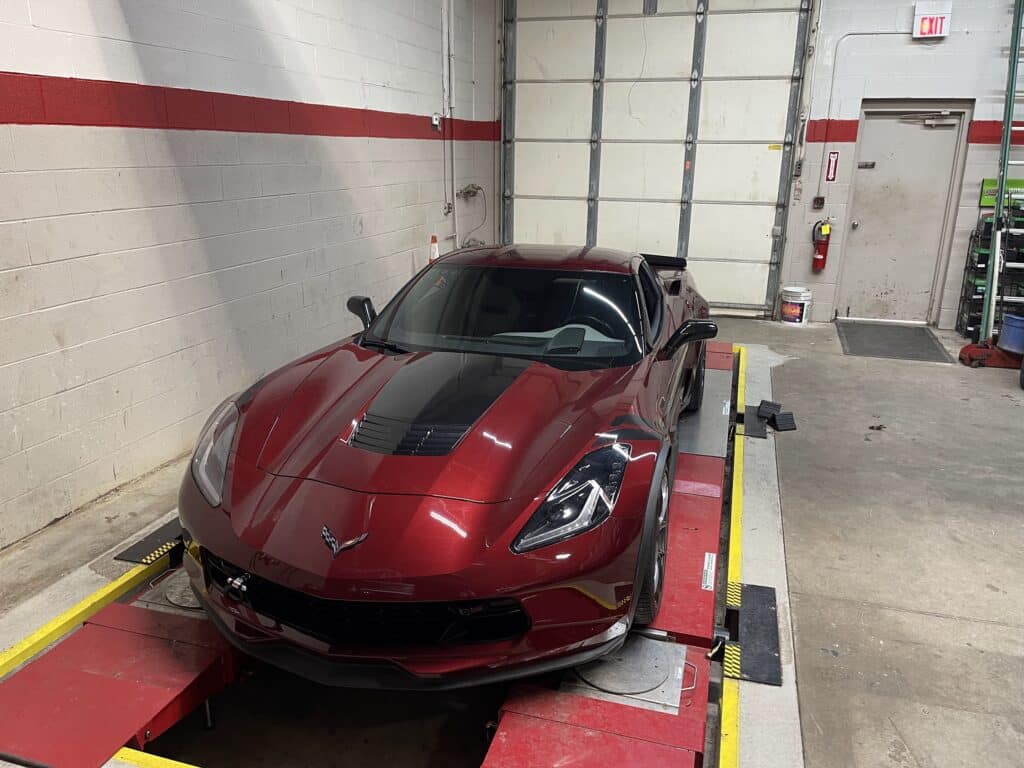
4. Corner Balancing: The Most Overlooked Step
You spent thousands on high-end coilovers. You set your ride height. You installed them with care. But you didn’t corner balance—and now the car feels twitchy, inconsistent, or unpredictable.
Corner balancing (also called cross-weighting) ensures that each tire carries the correct portion of weight at rest. It’s essential for:
- Predictable rotation and trail braking
- Even tire temps and wear
- Driver confidence under load
At Atomic, we use professional corner-weighting scales and make fine adjustments to spring perch heights to get balance dialed in—especially on platforms like the S2000, E46 M3, or GR86.
Goal: A balanced car that responds predictably every time you turn the wheel.
5. Alignment: The Final and Critical Step
After coilovers are installed and balanced, you must align the car. Ride height changes affect camber, caster, and toe—even if your arms haven’t moved.
We offer track and street-specific alignment services that take into account:
- Tire type and driving conditions
- Platform-specific geometry
- Preferred handling balance (aggressive vs. neutral)
- Future plans (more grip, aero, or power)
Our motorsports-grade alignment tools and experience mean we go beyond just “getting it in spec.” We deliver real-world performance based on your setup.
Goal: An alignment that works with your suspension—not against it.
Who This Applies To
This article is ideal for owners of:
- Mazda Miata (NA, NB, NC, ND)
- Honda S2000
- Toyota GR86 / Subaru BRZ
- Chevrolet Corvette (C5, C6, C7)
- BMW M3 / M2 / 3-Series
- Dual-purpose or fully track-prepped cars
Whether you’re on your first coilover install or upgrading from off-the-shelf kits, getting it right the first time will save you time, money, and frustration.

How Atomic Autosports Can Help
We don’t just install parts. We build cohesive suspension systems. At Atomic Autosports, coilover installs include the full range of services needed to get your car driving and handling the way it should:
- Consultation on coilover brand, spring rate, and damping options
- Professional installation and torque spec verification
- Ride height setup and fender clearance check
- Corner balancing with motorsport-grade scales
- Custom alignment for street, autocross, or track use
Whether you’re prepping for your first HPDE or fine-tuning a competitive build, we install and set up coilovers with the same attention to detail we give our own race cars.
Ready to Install Coilovers the Right Way?
If you’ve already picked out your coilovers or need help choosing the right kit, Atomic Autosports is ready to help. We serve drivers looking for precision suspension installs that are ready for real performance, not just lowered looks.