

If you’re searching for Subaru WRX STI alignment specs, understanding the correct setup for your specific generation can transform how your car performs on the street, at autocross events, or on track. The STI platform is built around a symmetrical all-wheel drive system that responds extremely well to precision alignment — but factory settings are engineered for comfort and tire longevity, not aggressive performance driving.
At Atomic Autosports in Wickliffe, Ohio, we work with WRX and STI owners from across Northeast Ohio and the Cleveland area who want to unlock the full potential of their AWD platform. Our shop specializes in performance alignments for street cars, autocross competitors, track day drivers, and SCCA racers.
This guide covers US-market Subaru WRX STI model years across three generations: the GD (2004–2007), the GR/GV (2008–2014), and the VA (2015–2021). Factory baselines and available adjustment ranges differ across generations — specific notes are included throughout.
Why Alignment Matters for the Subaru WRX STI
Because the STI sends power to all four wheels through active differentials, it is particularly sensitive to alignment settings. Misaligned wheels create tire scrub that fights the driveline, generating heat and reducing efficiency. Proper alignment ensures the AWD system works with your inputs rather than against them.
A dialed-in STI alignment delivers improved turn-in response and front-end grip, reduced understeer during hard cornering, better balance and rotation on corner exit, and more consistent tire wear across a full event. Drivers attending track days, autocross events, or SCCA competition benefit significantly from alignment tailored to how the car is actually driven.
AWD-Specific Alignment Considerations
The STI’s symmetrical AWD system creates unique alignment requirements compared to FWD or RWD platforms. Front-to-rear toe relationship directly affects driveline stress, and thrust angle alignment prevents the car from dog-tracking down the straight. Side-to-side camber matching ensures even tire loading, while caster settings influence steering feel and the dynamic camber gain you gain mid-corner.
The STI’s active center differential can mask minor alignment issues during casual driving — but track and autocross use will expose problems quickly. This is why choosing a shop that understands AWD alignment is critical. For a deeper dive into choosing the right setup for your discipline, see our guide on how to choose the right alignment specs for your motorsport.
Factory Alignment Specifications by Generation
Factory settings prioritize comfort, safety margin, and predictable understeer rather than outright performance. Understanding the baseline for your generation helps set realistic expectations about how much adjustment is achievable — and what hardware you may need.
2004–2007 STI (GD Generation)
| Parameter | Factory Target |
|---|---|
| Front Camber | Approx. −0.5° |
| Front Caster | Approx. +3.5° to +4.5° |
| Front Toe | Slight toe-in |
| Rear Camber | Approx. −1.0° to −1.3° |
| Rear Toe | Slight toe-in |
The GD chassis has notably less factory caster than later generations, which directly affects steering feel and dynamic camber gain. Aftermarket adjustable components are often required to reach aggressive performance targets on this platform.
2008–2014 STI (GR/GV Generation)
| Parameter | Factory Target |
|---|---|
| Front Camber | Approx. −0.5° to −0.8° |
| Front Caster | Approx. +5.5° to +6.0° |
| Front Toe | Slight toe-in |
| Rear Camber | Approx. −1.0° to −1.3° |
| Rear Toe | Slight toe-in |
The GR and GV generations introduced improved front suspension geometry and significantly more caster, making them more responsive to performance alignment work right out of the gate.
2015–2021 STI (VA Generation)
| Parameter | Factory Target |
|---|---|
| Front Camber | Approx. −0.6° to −0.9° |
| Front Caster | Approx. +6.0° to +6.5° |
| Front Toe | Slight toe-in |
| Rear Camber | Approx. −1.0° to −1.3° |
| Rear Toe | Slight toe-in |
The VA generation offers the most refined factory geometry of any US-market STI and responds very well to precision alignment tuning. It’s the most capable starting point for performance work.
Performance Street Alignment for WRX STI
A performance street alignment improves handling and grip while keeping tire wear and ride quality reasonable for daily driving. These targets apply broadly across the 2004–2021 STI range.
For the front suspension, we target −1.0° to −1.5° of camber, as much positive caster as adjustment allows (typically +6.0° to +7.0° on GR, GV, and VA platforms), and slight toe-in of approximately +0.05° to +0.10° total. The rear runs −1.0° to −1.3° camber with a matching slight toe-in.
These settings work well for spirited driving, autocross events, and occasional track days — a practical balance for drivers who still commute in their STI. GD generation owners should note that aftermarket camber bolts, camber plates, or adjustable control arms are often needed to reach these targets due to limited factory adjustment range.
Track Alignment for WRX STI
Track-focused alignment prioritizes maximum cornering grip and stability under load. These settings significantly increase tire wear during street driving but extract the full performance potential of the chassis.
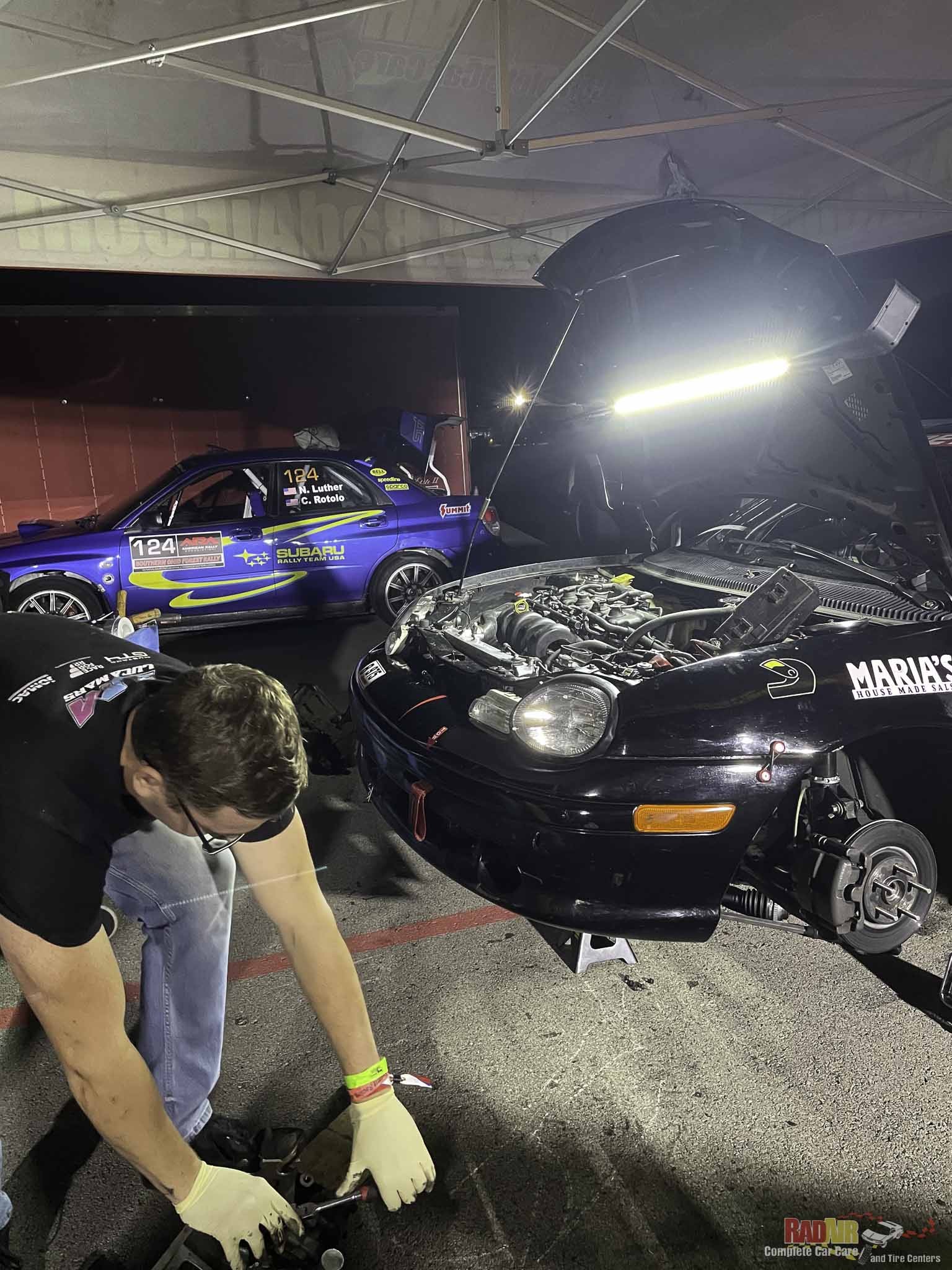
Up front, we’re targeting −2.0° to −2.5° of camber, maximum positive caster available, and neutral to very slight toe-out. The rear runs −1.8° to −2.2° camber with near-zero to slight toe-in for stability at speed.
The aggressive negative camber keeps the tire contact patch flat under hard cornering loads when the suspension compresses. Near-zero toe settings reduce tire scrub and heat buildup during extended sessions. Track alignments often require aftermarket components — adjustable front camber plates, adjustable rear lateral links, adjustable rear trailing arms, and coilovers with ride height adjustment. We can evaluate your car’s current hardware and recommend exactly what’s needed to reach your targets.
Autocross Alignment for WRX STI
SCCA autocross competitors running WRX or STI platforms typically use settings between street and track specs, depending on class rules and tire choice. The goal is sharp turn-in response and rotation without fully sacrificing tire life between events.
| Parameter | Autocross Target |
|---|---|
| Front Camber | −1.5° to −2.0° |
| Front Toe | Near zero or very slight toe-out |
| Rear Camber | −1.3° to −1.8° |
| Rear Toe | Slight toe-in for stability |
Class rules vary significantly across SCCA categories, so we work with drivers to stay legal while extracting maximum performance within those constraints. The combination of more aggressive camber and slightly open front toe delivers significantly better rotation on the tight, technical courses that define autocross.
Common STI Alignment Issues
Several alignment-related problems are common on modified or high-mileage STI platforms. Knowing the root causes helps you understand what’s actually happening when the car isn’t behaving right.
- Rapid inner tire wear — Usually results from excessive negative camber combined with aggressive toe-out, or from worn control arm bushings allowing alignment to shift dynamically under load.
- Steering pull or drift — Typically caused by cross-camber or cross-caster imbalance, bent suspension components, or worn bushings affecting one corner of the car.
- Unstable highway tracking — Often points to rear toe misalignment, a thrust angle problem, or subframe shifting from a prior impact.
- Excessive understeer beyond normal AWD characteristics — Can indicate too much front toe-in, insufficient front camber, or rear alignment issues upsetting the car’s balance.
Professional diagnosis with modern alignment equipment is essential to identify root causes rather than simply adjusting around symptoms. This is especially true for AWD platforms where multiple corners interact with each other through the driveline.
Frequently Asked Questions
How Often Should I Align My STI?
For street cars, every 10,000–12,000 miles or annually. For autocross and track cars, align before each season and after any significant suspension work, curb strike, or off-track excursion. A single hard contact with a curb can shift alignment enough to cost significant time.
Can I Use the Same Specs for My GD, GR, or VA STI?
The performance targets are similar across generations, but the GD chassis generally has less factory adjustment range and different caster characteristics. Each generation should be evaluated individually on the alignment rack rather than transferred spec-for-spec from another car.
Do I Need Aftermarket Parts to Align My STI for Performance?
It depends on your targets. Mild performance street specs are often achievable with factory hardware plus camber bolts. Aggressive track alignment typically requires camber plates, adjustable rear links, and coilovers. We’ll tell you exactly what you need — and what you don’t.
Will Performance Alignment Hurt My AWD System?
No — proper alignment actually reduces stress on the AWD system by eliminating tire scrub and driveline binding. Poor alignment is what causes premature driveline wear. Getting it right protects the car as much as it improves performance.
Will Track Alignment Ruin My Street Tires?
Aggressive track alignment increases inner edge wear during street driving, typically reducing tire life noticeably. For dual-purpose cars, a compromise street-and-track alignment is usually the best approach. We’ll walk you through the tradeoffs for your specific situation.
Why Subaru Owners Near Cleveland Choose Atomic Autosports
Located at 29251 Anderson Road in Wickliffe, OH, Atomic Autosports is trusted by WRX and STI owners from across Northeast Ohio and the Cleveland area. Our technicians understand AWD platforms and the STI’s specific geometry characteristics. We use precision alignment equipment designed for performance vehicles, and we tailor every setup to your driving goals — street, autocross, SCCA competition, or track days.
For WRX and STI owners who attend multiple events each season, our Apex Club Membership offers priority booking with as little as 24-hour notice, 15% off all services including alignments, an annual expert consultation for car setup and race prep, and VIP access to member-only track days — all for a first-year price of $129.55. For active autocross and track drivers, the service discount and priority scheduling alone often cover the cost of membership.
When precision and AWD expertise matter, Atomic Autosports is the trusted choice for Subaru WRX and STI alignment serving Northeast Ohio. Learn more about our full track preparation services to see everything we can do to get your STI dialed in before your next event.
Ready to Get Your STI Track Ready?
Our experienced motorsports team is here to get your Subaru WRX or STI dialed in and race-day ready.