
Atomic Autosports · Track Tire Setup
How Does Tire Pressure Affect Cornering Grip on Track?
Track tire pressure has a larger effect on cornering grip than most drivers realize, and running the same pressures you use on the street will cost you both grip and tire life on track. Atomic Autosports, located in Wickliffe, Ohio, helps drivers dial in tire pressures specific to their vehicle, tire compound, and event type across Northeast Ohio.
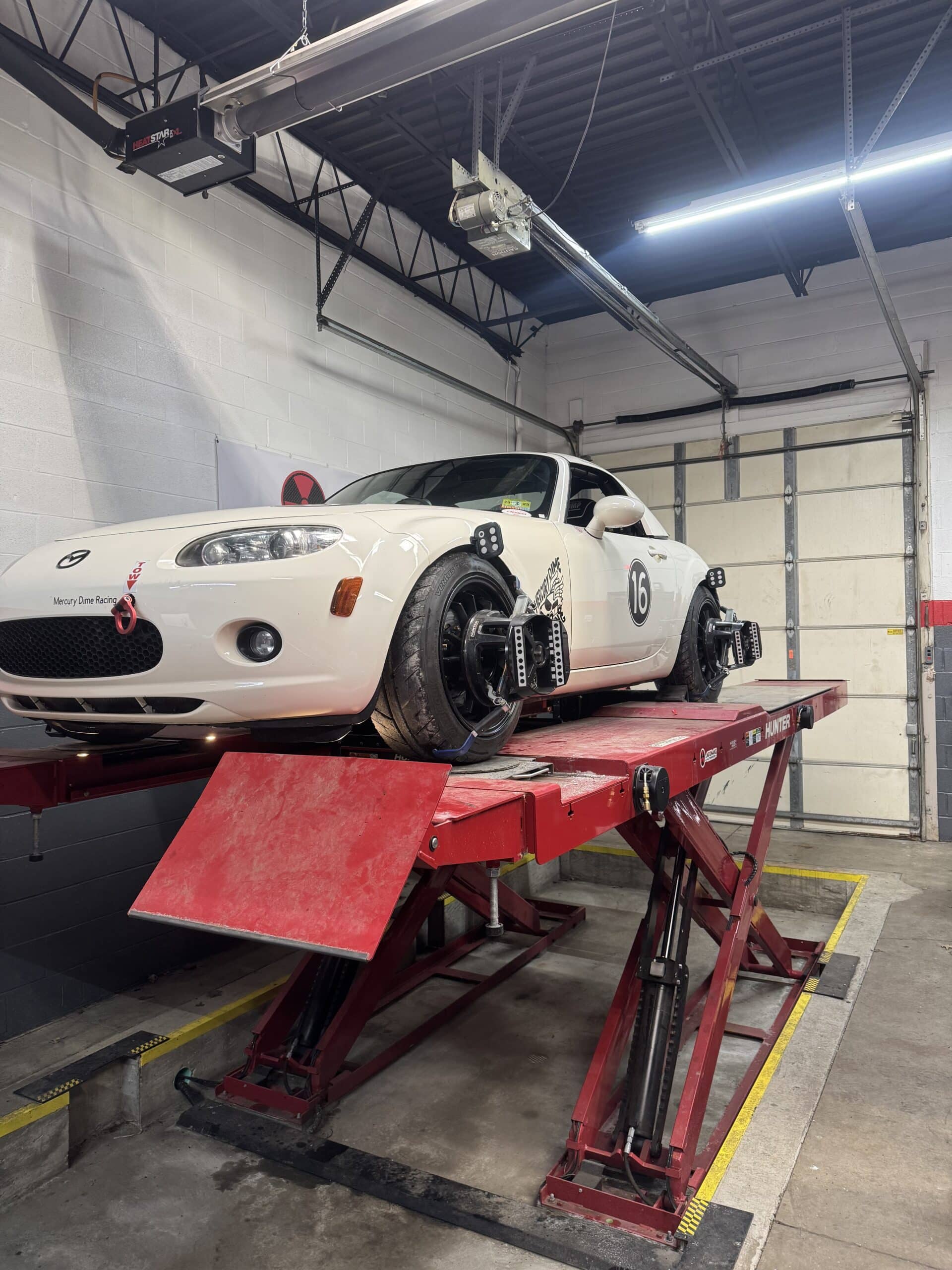
Why Track Tire Pressure Is Not the Same as Street Pressure
Tire pressure serves two competing purposes on any car, and the balance between them shifts dramatically the moment you enter a high-performance driving environment. On the street, pressure is set for ride comfort, load capacity, fuel economy, and long-term tread life at highway speeds. The manufacturer’s placard pressure on the door jamb reflects those priorities, not cornering performance.
On track, pressure controls how the tire’s contact patch behaves under lateral load. A tire that is over-inflated for the load it is carrying will crown up in the middle, reducing the size of the contact patch and dropping mid-corner grip. A tire that is under-inflated will roll onto its sidewall, chunk the outer shoulder, and feel vague and unpredictable at the limit. Getting track tire pressure right means finding the PSI where the entire tread face loads evenly during the hardest cornering the car will see that day.
Atomic Autosports approaches tire pressure as one variable in a larger chassis conversation. The team at the shop in Wickliffe, Ohio regularly sets up pressures for drivers heading to Nelson Ledges, Mid-Ohio, and Beaver Run, and the starting numbers are almost never what the tire sidewall recommends. They are what the tire needs to generate maximum lateral grip on that specific day, in that specific ambient temperature, with the specific tire and vehicle combination the driver is running.
How Tire Pressure Changes Cornering Grip
Cornering grip depends on the friction generated between the tire’s contact patch and the road surface. That friction scales with the size and uniformity of the contact patch, not just the load on the tire. When pressure is correct for the load, the contact patch is large, uniform, and stays flat against the pavement even as the chassis loads up laterally.
When pressure is too high, the sidewall becomes stiffer than needed and the middle of the tread carries most of the load. The outer shoulders lift slightly, reducing the working area of the tire. Drivers often report a hard, skittish feeling at the limit and a loss of predictability on corner entry. Tire wear tells the story clearly: the center of the tread wears faster than the shoulders.
When pressure is too low, the opposite happens. The sidewall folds under lateral load, the outer shoulder digs into the pavement, and the center of the tread lifts off. The tire feels soft and slow to respond, and heavy shoulder wear develops within a few sessions. On aggressive tires like 200 treadwear track compounds, this kind of wear can chunk the outer edge in a single day at temperatures above the tire’s recommended operating range.
The Tire Rack testing archive and various tire manufacturer resources document the same relationship across compound and construction types. The physics do not change by brand or model. What changes is the specific PSI window where each tire generates peak grip, which is why generic pressure recommendations from an online forum rarely match what a specific car needs on a specific track day.
Cold Versus Hot Tire Pressure: What the Numbers Actually Mean
The pressure you set in the paddock before a session is cold pressure. The pressure the tire runs at during the hardest part of the session, when the compound is at full operating temperature, is hot pressure. On a track tire under sustained cornering load, hot pressure typically climbs four to eight PSI above cold pressure, and for some sticky compounds in summer heat, the rise can be larger.
This matters because grip is determined by hot pressure, not cold. If your target hot pressure for a specific tire and vehicle combination is 32 PSI, and your tires gain six PSI during a session, you need to set cold pressures around 26 PSI in the paddock. Setting 32 PSI cold means driving on 38 PSI hot, which pushes the middle of the tread past its optimal loading and drops grip through the entire session.
Learning your car’s specific pressure rise is the practical work that separates dialed-in track drivers from drivers who are guessing. The pressure rise depends on ambient temperature, track surface temperature, tire compound, the aggressiveness of the driving, and the weight of the car. A heavier car with a stickier tire on a hot day will show a larger rise than a lighter car on a harder compound in cooler conditions.
The workflow at Atomic Autosports for a customer preparing for a track day is straightforward: establish a target hot pressure based on the tire and vehicle, note the ambient conditions expected at the event, and calculate a cold starting pressure that will land in the target window under load. Then the driver adjusts in the paddock between sessions using their own pressure gauge, ideally digital and recently calibrated, based on hot pressure readings taken immediately after the car comes off track.
Autocross Versus HPDE Versus Full Track Day: Why Pressures Differ
Not all performance driving loads a tire the same way. Autocross runs are 30 to 90 seconds long, with heavy transitions and low sustained load compared to a road course. HPDE sessions at Nelson Ledges or Mid-Ohio run twenty to thirty minutes with sustained cornering that puts consistent thermal load on the tire. A full track day event may include multiple sessions on the same set of tires with heat cycling between them. Each of these environments has a different optimal pressure window.
For autocross, the tire needs to reach operating temperature quickly and generate maximum grip in a short window. Autocross tire pressure recommendations from national-level SCCA competitors tend to run slightly higher than track day pressures for the same tire, because the tire never fully heat-soaks during a short run and needs more cold-side stiffness to feel responsive. The [SCCA](https://www.scca.com) and its member forums publish real-world pressure data across vehicle classes that reflect this pattern.
For HPDE and open track events, the tire spends more time at sustained temperature and load. Pressures set slightly lower than autocross recommendations, once the tire is fully up to temperature, tend to produce a larger and more uniform contact patch. Drivers commonly report needing to release two to four PSI between the first and second sessions of the day, as ambient warms and the tires settle in.
For time attack or endurance events with tighter tire life budgets, the goal shifts toward the pressure that produces the most consistent lap times over the length of a session, not just the single fastest lap. Atomic Autosports advises drivers preparing for these longer-format events to log pressures across sessions and track how they trend, so the setup can be tuned event by event rather than starting from scratch each weekend.
How Atomic Autosports Sets Up Your Track Tire Pressure
Atomic Autosports approaches track tire pressure setup as part of the same pre-event preparation that covers alignment, brake assessment, and fluid service. The team at the shop at 29251 Anderson Road in Wickliffe, Ohio works with drivers running everything from a Miata on 200 treadwear tires at a local autocross to a C7 Corvette on R-compound tires at Mid-Ohio, and the process adapts to the platform and event.
The starting point is understanding what tire the driver is running, what tire pressure the manufacturer recommends for high-performance use, and what the vehicle weighs on each corner. Corner weights affect the load on each tire, and cars that are not corner-balanced will show different pressure rise on the loaded diagonal than on the unloaded corners. This is one of the specific reasons the shop recommends corner balancing as part of comprehensive suspension setup for anything more than casual track use.
For customers who are Apex Club members at Atomic Autosports, priority scheduling with 24-hour notice for most appointments means pre-event tire pressure setup can be handled without the usual scheduling pressure of summer track season. The membership includes fifteen percent off parts and labor up to $150 per visit, which helps when tire setup work leads into other pre-event services like fresh brake fluid, an alignment check, or a fluid top-off. You can join at atomicautosports.com/product/apex-club/.
Reading Your Tires After a Session for Real Feedback
The most useful tire pressure feedback comes from the tires themselves, immediately after a session ends. Two data points matter: the hot pressure reading with a calibrated gauge, and the visual condition of the tread across the full face of the tire.
Hot pressure that is above your target window means the cold starting pressure was too high. Release air until you return to the target for the next session. Hot pressure below target means the cold starting pressure was too low, or the tires did not reach full operating temperature during the session — either from a shorter run than expected or cooler ambient conditions than planned.
Visual tread inspection is where most drivers stop paying attention, but the wear pattern after a single session tells you whether the tire is loading correctly. Even wear across the tread face means the pressure and camber combination is close to optimal for that session’s conditions. Heavy inside-edge wear with fresh outer edges usually points to too much negative camber for the pressure and cornering load. Heavy outer-edge wear suggests the tire is folding onto its sidewall under lateral load — pressure is likely too low for the compound and driving style.
If you listen to the Late to Grid podcast at atomicautosports.com/late-to-grid/podcast/, tire pressure comes up regularly because it is one of the variables drivers most often get wrong before they realize what is costing them lap time. The show covers real-world pressure data from Northeast Ohio track events and the specific patterns Atomic Autosports sees across the platforms it services.
Frequently Asked Questions
Common Questions
What tire pressure should I start with at a track day?
The correct starting pressure depends on the tire, the vehicle, and the expected ambient temperature at the event, not a single universal number. As a general framework, cold pressures set four to eight PSI below the target hot pressure for that tire and platform usually land in a reasonable operating window. Atomic Autosports in Wickliffe, Ohio sets cold starting pressures based on the specific tire, vehicle weight, and event type each customer is preparing for, and adjusts the recommendation for the conditions of the day.
Should track tire pressure be higher or lower than street pressure?
Track tire pressure is almost always lower than the door-jamb street recommendation once the tire is at operating temperature, because sustained cornering load raises pressure significantly through a session. Cold pressures set for track use typically start below the street placard number so that the hot pressure lands in the tire’s optimal grip window. Atomic Autosports evaluates this for each vehicle individually because platform, tire compound, and driving style all affect where the correct number lands.
Why does my tire pressure go up after a session?
Tire pressure rises during a session because the sustained cornering load, braking, and acceleration generate heat inside the tire, and heated air expands in a fixed volume. On a 200 treadwear tire under aggressive HPDE use, pressure typically rises four to eight PSI from cold to hot. Softer R-compound tires in summer conditions can rise more. This is why Atomic Autosports focuses on hot pressure, not cold, when setting up a car for track day performance.
Does tire pressure affect wear as much as camber does?
Tire pressure and camber both affect wear, but they affect different areas of the tread. Camber that is too aggressive concentrates wear on the inside edge of the tire, while pressure that is too high or too low affects wear distribution across the tread center and shoulders. Both need to be dialed in together for a track setup to work efficiently, which is why Atomic Autosports evaluates alignment and tire pressure as connected variables rather than independent adjustments.
What tools do I need to monitor tire pressure at the track?
At minimum, a quality digital tire pressure gauge with 0.5 PSI resolution and a portable air compressor or hand pump that can add or release pressure quickly between sessions. Analog gauges are often less consistent than digital under track conditions and can drift over time. Atomic Autosports recommends drivers running frequent track events verify their gauge against a calibrated reference at the shop at least once per season to make sure the numbers they are chasing at the paddock are accurate.
Ready to Book?
Get Your Track Tire Setup Dialed In
If you have been guessing at tire pressure or running street settings at track days, book a track tire setup consultation at Atomic Autosports before your next event.
29251 Anderson Rd · Wickliffe, OH 44092
Mon–Fri · 8am–5:30pm