
Walk into any paddock at an autocross event, track day, or road race, and you’ll hear drivers debating alignment specs. “I’m running -2.5 degrees of camber up front.” “My friend swears by 1/16-inch toe-out.” “Should I add more caster?”
These conversations matter because alignment specifications-camber, toe, and caster-are among the most powerful tuning tools available to grassroots motorsports competitors. But here’s the challenge: the “perfect” alignment for autocross isn’t ideal for road racing. Track day settings differ from time attack requirements. And what works brilliantly on a front-wheel-drive Honda doesn’t translate directly to a rear-wheel-drive BMW.
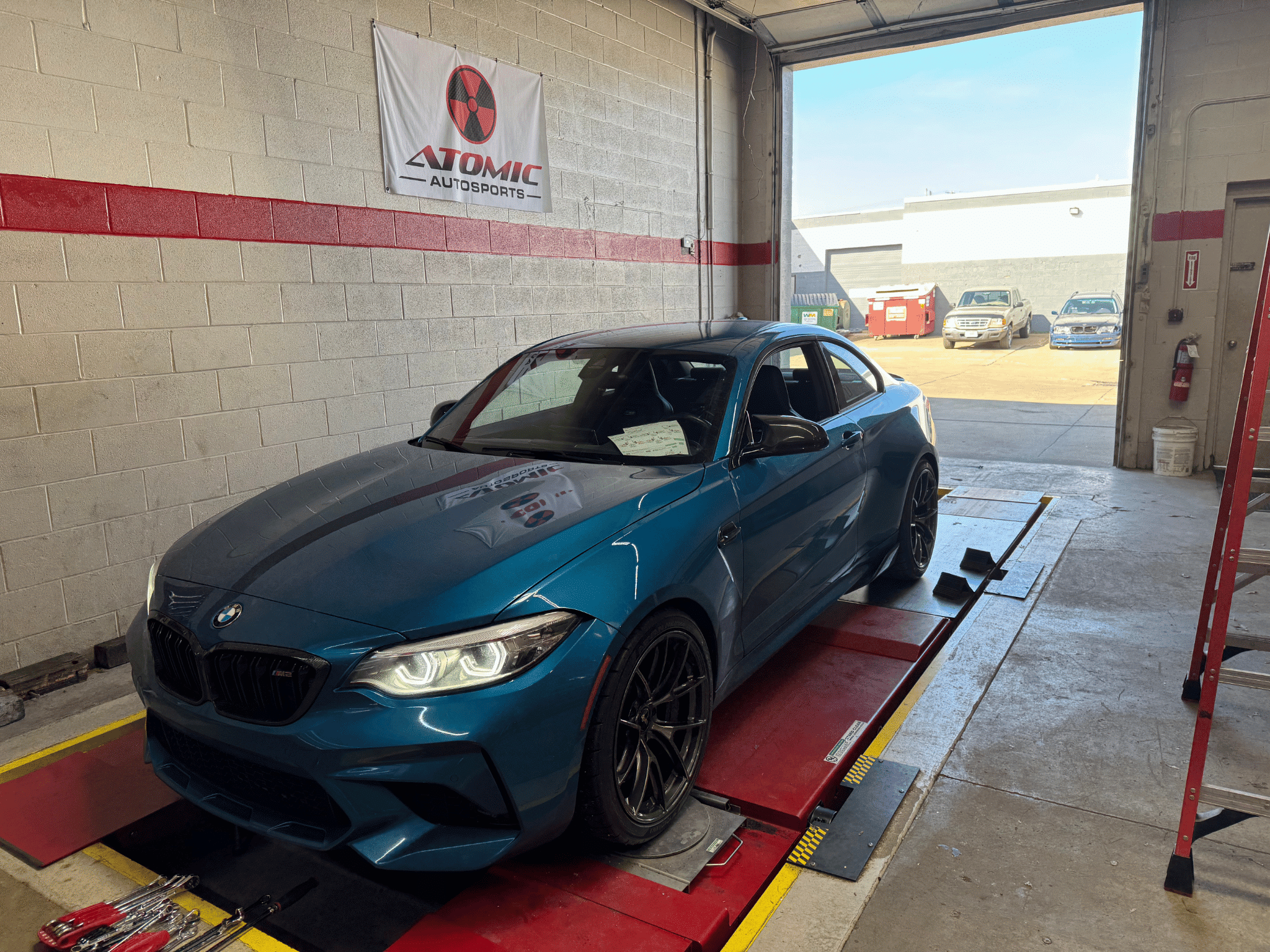
At Atomic Autosports, we align dozens of competition cars every month across multiple disciplines-SCCA autocross, NASA road racing, ChampCar endurance events, HPDE track days, and more. Through this experience, we’ve learned that choosing the right alignment specs isn’t about copying someone else’s numbers. It’s about understanding what each adjustment does, how your specific motorsport demands differ, and what your car’s suspension geometry allows.
This guide breaks down alignment fundamentals and provides starting point recommendations for different motorsports disciplines to help you dial in your setup with confidence.
Understanding Alignment Fundamentals
Before diving into sport-specific recommendations, let’s establish what each alignment angle does and how it affects your car’s behavior.
Camber: The Tilt of Your Wheels
Camber is the inward or outward tilt of your wheels when viewed from the front of the car. Negative camber means the tops of the tires lean inward toward the chassis. Positive camber means they lean outward.
During cornering, your car’s body rolls and the suspension compresses on the outside wheels. This body roll causes the tire’s contact patch to roll onto the outer shoulder. Negative camber compensates for this, keeping the tire flatter on the road during hard cornering and maximizing the contact patch when you need grip most.
Too little negative camber and your tire rolls onto its outer shoulder during cornering, reducing grip and causing excessive outer edge wear. Too much negative camber and you sacrifice straight-line grip (important for acceleration and braking) while causing excessive inner edge wear. The goal is finding the sweet spot that maximizes grip during cornering without giving up too much straight-line performance.
Toe: The Direction Your Wheels Point
Toe describes whether your wheels point toward each other (toe-in) or away from each other (toe-out) when viewed from above. Toe is typically measured in degrees or fractions of an inch.
Toe settings dramatically affect turn-in response and stability. Toe-out makes the car more responsive and eager to turn in, which is desirable for tight autocross courses or technical road course sections. However, too much toe-out creates instability at speed and increases tire scrub, causing excessive wear.
Toe-in increases stability, particularly at high speeds, making the car feel more planted and predictable. The downside is reduced turn-in response-the car feels less eager to change direction. For most racing applications, we use minimal toe (close to zero) or slight toe-out for improved response.
Caster: The Steering Axis Angle
Caster is the forward or backward tilt of the steering axis when viewed from the side. Positive caster means the steering axis tilts backward (toward the driver at the top).
More positive caster increases straight-line stability and provides more negative camber gain during steering input-the outside front wheel gains negative camber as you turn in, improving grip mid-corner. Caster also affects steering effort and feedback. More caster generally means heavier steering but better feel.
Most modern performance cars come with significant positive caster from the factory. Unless you’re running adjustable upper control arms or offset bushings, caster is often the least adjustable alignment angle. However, when adjustment is available, more caster is generally beneficial for track use, providing improved stability and better camber curves.
Alignment Specs by Motorsport Discipline
Different motorsports place different demands on your car, which means optimal alignment specs vary considerably between disciplines. Here’s what we recommend at Atomic Autosports based on hundreds of alignments across multiple racing series.
Autocross and Solo Competition
Autocross courses feature tight corners, quick transitions, and relatively low speeds. Turn-in response is critical-you need the car to change direction instantly. Straight-line stability matters less since speeds rarely exceed 60-70 mph and straights are short.
Recommended Starting Points:
Front Camber: -2.5° to -3.5° (more is better if tire wear is acceptable and class rules allow)
Rear Camber: -2.0° to -3.0° (match or slightly less than front)
Front Toe: 1/32″ to 1/16″ toe-out (improves turn-in response)
Rear Toe: 1/16″ to 1/8″ toe-in (provides stability on power application)
Caster: Maximum positive caster available (usually 6° to 9° depending on chassis)
For autocross, we typically push camber as aggressive as tire wear and class rules permit. The improved cornering grip outweighs any straight-line performance loss. Front toe-out helps with the quick direction changes autocross demands, while rear toe-in keeps the car stable under power and during transitions.
One key consideration: if you’re running street tires (especially all-seasons), you can’t run as much negative camber as you would on R-compounds or slicks. Street tires have rounder shoulders and don’t benefit from extreme camber the same way competition tires do. We typically recommend staying under -2.5° camber for daily-driven autocross cars on street tires.
Track Days and HPDE
High-Performance Driving Education focuses on learning proper racing lines, improving car control, and gradually building speed. For HPDE participants, we balance performance with street drivability since many track day cars are driven to and from the circuit.
Recommended Starting Points:
Front Camber: -2.0° to -2.8°
Rear Camber: -1.5° to -2.3°
Front Toe: 0° to 1/32″ toe-out
Rear Toe: 1/16″ toe-in total
Caster: Maximum positive caster available
Track day alignments prioritize a balance between performance and practicality. Unless you’re running dedicated track wheels and tires, you want specs that work well at both the track and during the drive home. Moderate camber provides good grip during spirited driving without destroying street tire wear during commuting.
As you progress through HPDE groups and become more confident pushing the car’s limits, you can gradually increase camber to improve cornering performance. Many of our regular track day customers at Mid-Ohio Sports Car Course start with moderate specs and adjust more aggressively as their skills develop and they commit to the hobby.
Wheel-to-Wheel Road Racing
Road racing-whether SCCA Club Racing, NASA, or endurance series like ChampCar-demands a different approach than autocross. Speeds are higher, straights are longer, and consistency over multiple laps matters more than peak grip in a single corner. Tire management becomes critical, especially in endurance racing where you need to stretch stints.
Recommended Starting Points:
Front Camber: -2.5° to -3.2°
Rear Camber: -2.0° to -2.8°
Front Toe: 0° to 1/32″ toe-out
Rear Toe: 1/16″ to 1/8″ toe-in total
Caster: Maximum positive caster available
Road racing alignments emphasize consistency and tire life while maintaining strong cornering performance. We typically run slightly less aggressive camber than autocross (where you’re only concerned about one 60-second run) because tire wear over a 30-minute sprint race or 8-hour endurance event becomes a limiting factor.
Toe settings are critical for road racing. Excessive toe (either in or out) creates tire scrub and heat, accelerating wear and potentially causing tire failures during long stints. We aim for minimal toe settings that provide adequate turn-in response without sacrificing tire longevity.
Our ChampCar endurance racing team has learned that conservative alignment specs often win races. The team that can run one fewer pit stop because their tires lasted longer beats the team with slightly more aggressive specs who had to pit an extra time.

Time Attack and Track Records
Time attack competition is all about extracting the absolute maximum from your car over a single flying lap or short session. Tire longevity doesn’t matter-only outright grip and lap time. This allows for the most aggressive alignment specs.
Recommended Starting Points:
Front Camber: -3.0° to -4.0° (limited mainly by tire design and class rules)
Rear Camber: -2.5° to -3.5°
Front Toe: 1/32″ to 1/16″ toe-out
Rear Toe: 1/16″ toe-in to 1/32″ toe-out (depending on chassis balance)
Caster: Maximum positive caster available
Time attack alignments prioritize peak performance above all else. We run aggressive negative camber to maximize cornering grip, accepting that straight-line acceleration and tire wear will suffer. Many time attack cars are trailered to events, so street drivability isn’t a concern.
Rear toe becomes a powerful tuning tool for time attack. Slight rear toe-out can help rotate the car and improve mid-corner balance, though it requires careful testing since it can make the car nervous at speed. We typically start with toe-in for stability and only move to toe-out if the car exhibits terminal understeer that can’t be fixed through other means.
Drifting and Angle Competition
Drifting requires unique alignment specs because the goal isn’t maximum grip-it’s controlled, sustained oversteer with precise throttle control and steering angle management.
Recommended Starting Points:
Front Camber: -2.5° to -4.0° (varies significantly by style and tire)
Rear Camber: -2.0° to -3.0°
Front Toe: 0° (parallel is common, though some run slight toe-out)
Rear Toe: 1/8″ to 1/4″ toe-in (promotes stability during transitions)
Caster: Maximum positive caster available (often 8° to 12° with modified steering angle kits)
Drift alignment specs vary more than any other discipline based on driver preference, tire choice, and desired angle. Aggressive front camber on the drift “outer” wheel (the side that’s typically sliding) helps maintain grip during extreme steering angles. Rear camber helps control tire temperature and wear during sustained slides.
Rear toe-in is critical for drift stability. More rear toe-in makes the car more stable during transitions and helps prevent the rear from swapping directions unpredictably. Many drift competitors run significantly more rear toe-in than other motorsports would tolerate.
Street Performance and Canyon Driving
Not everyone competes, but many enthusiasts want their street car to handle better on favorite backroads while maintaining daily drivability and acceptable tire wear.
Recommended Starting Points:
Front Camber: -1.5° to -2.2°
Rear Camber: -1.2° to -1.8°
Front Toe: 0° to 1/32″ toe-out
Rear Toe: 1/16″ to 1/8″ toe-in total
Caster: Maximum positive caster available
Street performance alignments balance spirited driving enjoyment with practical considerations like tire wear, ride comfort, and steering effort. Moderate negative camber improves handling without destroying tire life during commuting. Minimal toe reduces tire scrub and wear while maintaining acceptable turn-in response.
This setup makes your car noticeably more capable and confidence-inspiring on twisty roads while remaining perfectly comfortable for daily driving. Many of our customers report that this alignment transformation was the best value modification they’ve made to their car.
Fine-Tuning Your Alignment
These recommendations provide starting points, but every car and driver combination is different. Here’s how we approach fine-tuning at Atomic Autosports:
Start Conservative, Add Gradually
It’s easier to add more negative camber or adjust toe settings after testing than it is to back off from too-aggressive specs that caused problems. Start with moderate settings within our recommended ranges, test at an event or track day, then adjust based on tire wear patterns and handling feedback.
Read Your Tires
Tire wear patterns tell you exactly what your alignment is doing. Excessive outer edge wear means you need more negative camber. Inner edge wear indicates too much negative camber for your application. Feathering across the tread surface suggests too much toe. Learn to read these signs and adjust accordingly.
Consider Your Tire Compound
R-compound competition tires and slicks benefit from more aggressive camber than street tires. The stiffer sidewalls and flatter tread profiles of competition tires work optimally with 0.5° to 1.0° more negative camber than street tires on the same car.
Track-Specific Adjustments
Some tracks favor different alignment specs. Tight, technical circuits like Nelson Ledges benefit from more aggressive turn-in settings (toe-out). Fast, flowing tracks like Mid-Ohio reward stability and consistency. If you consistently run the same venue, you can optimize specifically for that circuit.
Document Everything
Keep detailed records of your alignment specs, tire pressures, and handling characteristics. This documentation becomes invaluable when troubleshooting issues or making adjustments. We provide every customer with detailed spec sheets for exactly this reason.
Want to Learn More? Check Out Our Podcast
Looking for more in-depth discussions about alignment, setup, and motorsports preparation? The Atomic Autosports team hosts Late to Grid, a podcast dedicated to grassroots racing and performance driving.
We interview drivers, industry insiders, and technical experts who share real-world insights on everything from alignment strategies to race prep to getting started in motorsports. Recent episodes have covered topics like:
- Optimal alignment specs for different SCCA autocross classes
- How professional drivers approach suspension setup
- Track day preparation and what to expect at your first HPDE
- Endurance racing tire management strategies
- Corner balancing techniques and real-world results
Whether you’re commuting, wrenching in the garage, or driving to your next event, Late to Grid provides the knowledge and inspiration to improve your motorsports journey.
New episodes release regularly featuring guests from SCCA, NASA, ChampCar, and the broader grassroots motorsports community. Subscribe to stay updated on the latest setup tips, racing stories, and technical insights from people who live and breathe motorsports.
Class Rules and Alignment Restrictions
Before making alignment changes, understand your competition class rules. Different classes have different limitations:
- Street Class (SCCA Autocross): Limited to OEM adjustment ranges. You can adjust within factory specs but can’t add camber plates or other modification to gain more range.
- Street Touring: Allows camber plates, adjustable suspension arms, and most alignment modifications. This is where aggressive specs become possible.
- Street Prepared and Higher: Essentially unlimited alignment adjustment capability, restricted mainly by tire choice and physics.
- Time Attack Classes: Rules vary by series and class but generally allow aggressive alignment modifications.
- Road Racing: Most series allow significant alignment adjustment, though some Production classes limit modifications.
Always verify your class rules before making alignment changes or modifications. At Atomic Autosports, we stay current with SCCA, NASA, and other series rulebooks to ensure your alignment keeps you competitive and legal.
The Apex Club Advantage for Alignment Services
If you’re actively competing in any motorsport discipline and making regular alignment adjustments based on tire wear, handling feedback, or track-specific optimization, the Atomic Autosports Apex Club delivers significant value.
Apex Club members receive 15% off all alignment services (up to $150 per visit), which adds up quickly when you’re checking alignment multiple times per season. Priority booking means you’re not scrambling to get aligned before event day-crucial when you notice uneven tire wear mid-season or want to test different specs.
For serious competitors who understand that alignment is an ongoing optimization process rather than a set-it-and-forget-it service, the Apex Club typically pays for itself within 2-3 alignment visits while providing year-round priority access and dedicated member support.
Many of our Apex Club members experiment with different alignment specs throughout the season, using their membership discount to affordably test variations and find optimal settings for their specific car and driving style.
Professional Alignment Makes the Difference
Choosing the right alignment specs is only half the battle-executing those specs with precision is equally important. A tenth of a degree of camber or 1/32-inch of toe can noticeably affect handling characteristics. Consumer-grade alignment shops lack the expertise to translate your performance goals into optimal settings and the precision equipment to achieve them accurately.
At Atomic Autosports in Wickliffe, Ohio, we specialize in performance alignments for motorsports applications. Our team actively races in SCCA, ChampCar, and NASA events, so we understand the handling characteristics you’re seeking because we chase them ourselves. We use professional-grade alignment equipment with 0.01-degree accuracy and provide detailed spec sheets documenting every measurement.
Whether you’re running your first autocross in Street class, preparing for an HPDE weekend at Mid-Ohio, building a time attack car, or competing in wheel-to-wheel road racing, we have the experience to help you dial in alignment specs that maximize your car’s potential within your class rules and driving goals.
Frequently Asked Questions About Alignment Specs
How do I know if my current alignment is wrong for my motorsport?
Common signs include: the car feels different in left versus right turns, excessive tire wear on specific edges, the car doesn’t feel stable at speed, or turn-in response is too slow or too aggressive. Comparing your current specs against our recommended ranges for your discipline often reveals opportunities for improvement. Bring your car to Atomic Autosports for an alignment inspection. We’ll measure your current specs and discuss how they align with your motorsport goals.
Can I use the same alignment specs for street driving and track use?
It depends on how aggressive your track specs are and how much tire wear you’re willing to accept. Moderate track day specs (around -2.0° to -2.5° camber) work fine for street use with reasonable tire wear. Aggressive time attack or autocross specs (-3.0° or more camber) will cause rapid tire wear during daily driving. Many competitors run two sets of wheels and get different alignments for street and track setups.
Should I match the front and rear camber?
Not necessarily. Most cars benefit from slightly more negative camber in front than rear to balance handling. Front-wheel-drive cars especially need aggressive front camber since those tires handle steering, braking, and acceleration forces. Rear-wheel-drive cars can often run more balanced front-to-rear camber. The key is testing and adjusting based on handling balance and tire wear patterns.
How often should I check my alignment?
Check alignment at the start of each season, after any suspension work or modifications, after hitting curbing hard or experiencing suspension impacts, and if you notice uneven tire wear or handling changes. Serious competitors often verify alignment before major events. Apex Club members can schedule quick alignment checks throughout the season at a discounted rate to catch issues early.
What’s more important: camber, toe, or caster?
All three matter, but camber typically has the largest impact on cornering grip. If you can only adjust one angle, maximize negative camber within acceptable tire wear limits. Toe affects turn-in response and stability significantly but causes rapid tire wear if set incorrectly. Caster improves stability and provides dynamic camber gain, but many cars have limited caster adjustability without modification.
Will more negative camber always make my car faster?
Only to a point. Excessive negative camber reduces straight-line grip for acceleration and braking while causing inner edge tire wear. There’s an optimal range where you maximize cornering grip without sacrificing too much straight-line performance. That range depends on your tire compound, suspension design, and motorsport discipline. We help you find that optimal balance through testing and adjustment.
Can an alignment fix my car’s handling problems?
Alignment is a powerful tuning tool, but it can’t fix fundamental issues like worn suspension components, inappropriate spring rates, or insufficient anti-roll bar stiffness. We always inspect suspension condition before alignment. If we find worn bushings, ball joints, or other components, those should be addressed first. Once the suspension is mechanically sound, proper alignment can dramatically improve handling characteristics.
How do I adjust alignment for different tracks?
Some competitors carry alignment shims or adjustable suspension components to make track-specific changes. For example, adding toe-out for a tight technical circuit or increasing rear toe-in for a fast, flowing track. If you frequently run different venues with different characteristics, we can document multiple alignment setups for different tracks. Most drivers find one well-balanced alignment works adequately for all tracks within a region.
What alignment changes should I make if I’m experiencing understeer or oversteer?
For understeer (car won’t turn in), try: more front negative camber, less front toe-in (or add toe-out), less rear negative camber, or more rear toe-in. For oversteer (rear steps out too easily), try: more rear negative camber, less rear toe-in (or add slight toe-out), less front negative camber, or more front toe-in. However, these are generalizations-proper diagnosis requires understanding your specific car’s suspension geometry and chassis balance. We can help diagnose and recommend the right alignment changes for your handling issues.
Get Expert Alignment Services
Ready to optimize your alignment specs for your specific motorsport? Schedule your performance alignment at Atomic Autosports.
Contact Us Today
Wickliffe, OH 44092
Sat: By appt only
About Atomic Autosports
Atomic Autosports is Northeast Ohio’s premier destination for performance alignment services and motorsports preparation. Our team actively competes in SCCA autocross and road racing, ChampCar endurance events, and NASA competitions, bringing real-world racing experience to every alignment we perform. We understand the specific demands of different motorsports because we compete in them ourselves. Located in Wickliffe, OH, we serve motorsports enthusiasts throughout Cleveland, Lake County, and the greater Northeast Ohio region.
Join Our Community
Follow us for setup tips, alignment insights, and local autocross event coverage.
Looking for wheel alignment near me for your autocross car? You just found the best in Northeast Ohio.
Ready to Get Track Ready?
Our experienced motorsports team is here to get your car dialed in and race-day ready.
Schedule Service